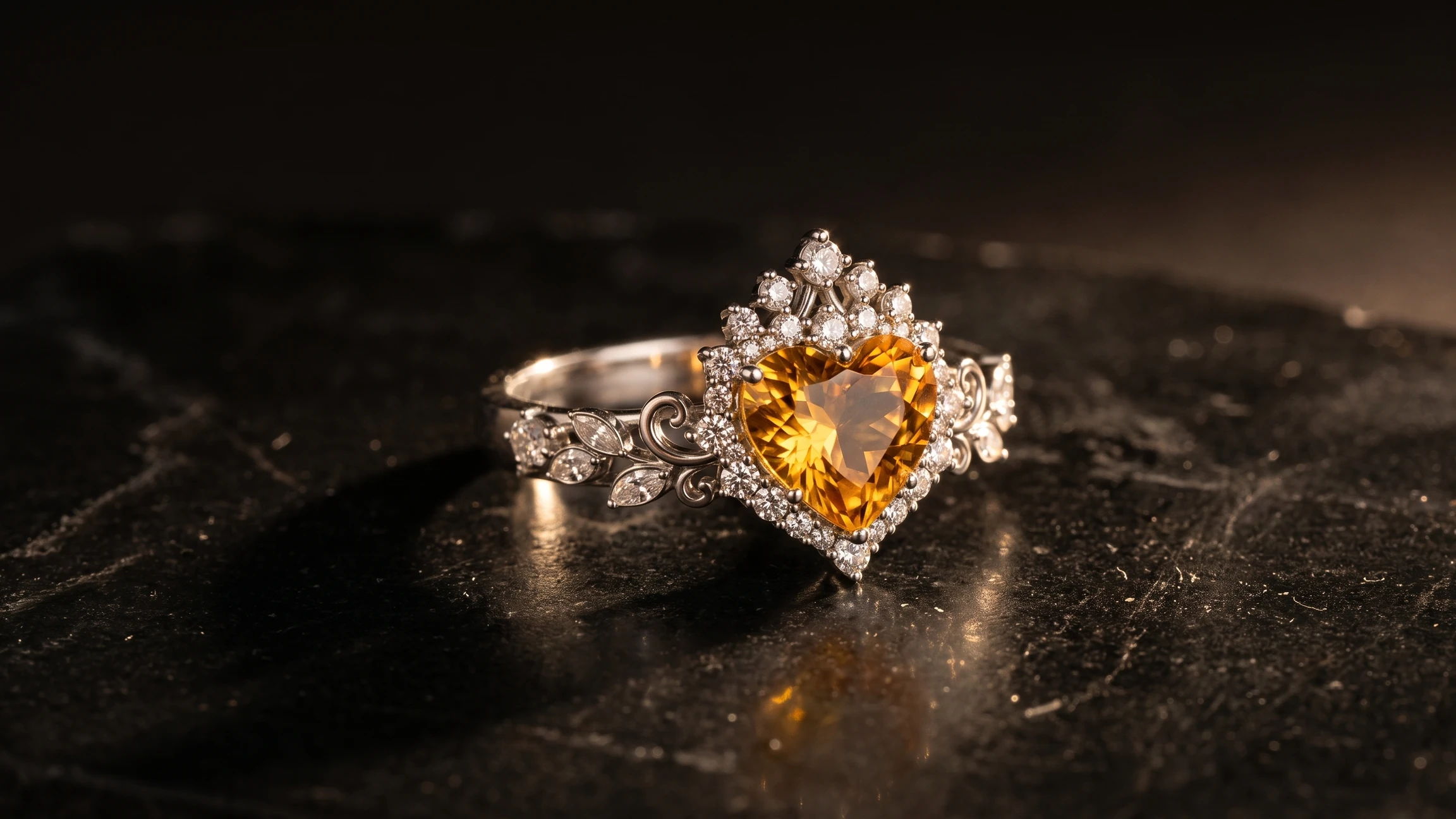
Two rubies sit on the tray. They are the same weight, close enough in colour that you would have to put them side by side to separate them, and both are clean to the eye. One is several times the price of the other. Nothing you can see accounts for the difference. What accounts for it is an event that may or may not have happened to one of them in a furnace, decades ago, in a workshop no one can now name.
What heating actually does
Ruby is corundum coloured red by chromium. Two things commonly stand between a rough crystal and a fine stone: fine needles of rutile — the silk — scattering light and clouding it, and iron and titanium sitting in the lattice in a way that pushes the colour towards purple or brown. Sustained heat addresses both. The silk dissolves back into the structure and the stone clears; the trace elements redistribute and the red opens up.
The result is permanent and stable. It is not a coating, it does not fade, and it will not be undone by ordinary wear or by a jeweller’s bench. In some form the practice is old — heating corundum to improve it is documented for centuries, long before anyone could explain why it worked.
Why the trade accepts it
Because without it there would be almost no fine ruby to sell. The great majority of the world’s corundum arrives from the ground needing help, and heat is what makes a commercial supply exist at all. A heated ruby is not a damaged ruby or a fake one. It is the normal state of the material.
What the trade requires is not that heat be avoided, but that it be declared. An undisclosed treatment is the offence; the treatment itself is not.
Why an unheated ruby costs what it does
Scarcity of a particular kind. An unheated stone of fine colour is a stone that needed nothing done to it — one that grew under conditions that happened to produce, unassisted, what a furnace is otherwise required to coax out. Those conditions are uncommon, and the stones that record them are correspondingly few.
You are not paying for the absence of a process. You are paying for the evidence that the process was never necessary.
That is a real distinction and it survives scrutiny, which is why the premium has held for as long as it has. It is also, precisely because it is invisible in the stone, the easiest claim in the trade to make loosely.
What “no indications of heating” means
This is the sentence you are buying, and it is worth noticing how carefully it is worded. A laboratory does not write unheated. It writes that it found no indications of heating, because heating is not observed directly — it is inferred from what it leaves behind.
- Rutile silk that has begun to dissolve, or has been partially reabsorbed, rather than sitting as the sharp needles an untouched stone carries.
- Discoid fractures — small disc-shaped stress halos around crystal inclusions, where the inclusion and its host expanded at different rates.
- Crystal inclusions that have melted, rounded off, or recrystallised in a way they would not have done underground.
Where a stone was heated hard, these traces are unmistakable. Where it was heated gently, at lower temperatures, they can be faint, ambiguous, or absent altogether. And a stone with very few inclusions offers little for the evidence to be written on in the first place. The laboratory’s phrasing is an honest account of an inference, not a hedge — and it is the reason a report from a laboratory with a long reference collection and a reputation to lose is worth what it costs on a stone at this level.
The category this is not an argument about
Lead-glass filled material — sold in the market as composite ruby — is not a heated ruby and does not belong in the same conversation. Fractured low-grade corundum is impregnated with high-refractive-index glass, producing something that looks far better than the material inside it, is fragile, and can be damaged by ordinary bench work or even by a jeweller’s cleaning solution. It is worth a small fraction of an untreated stone it superficially resembles. A report will name it, which is one more reason to read the report before the stone.
Heat and origin are two questions, not one
They are frequently sold as a single virtue — unheated Burmese — and they price separately. A stone can be unheated and from a deposit that carries no premium; it can be Burmese and heated. Each attribution is a distinct opinion from the laboratory, each rests on different evidence, and each can be absent without impugning the other. Why the second one moves a price as far as it does is a separate subject.
Before you agree to one
- Get the report first, and read the treatment line before the colour line. On a stone at this price the report should be current, and from a laboratory whose standing you can verify independently.
- Check the weight and all three measurements against the stone in front of you, not only the weight.
- Read the comments at the foot of the report. Qualifications on treatment are often placed there rather than in the body.
- Ask what the stone would be worth if the report said heated. If the seller cannot answer, they have not priced the risk you are being asked to carry.
- See it in daylight and under warm light. Ruby flatters itself under the lighting of a jeweller’s room, and an unheated stone is not exempt from that.
- Treat any unheated claim with no report behind it as a claim about the seller, not about the stone.
How the House buys
SINGULLUM states the treatment of a stone whatever it is, and does not present an untreated stone as a moral quality — heat is a normal and legitimate part of the trade, and a heated stone of real character is a better stone than an unheated one without it. What the House will not do is let an absence go unstated in either direction. Every Creation is delivered with the independent report for its stone, and the commission begins with the stone rather than with a specification it has to satisfy.
Written to inform. It is not a valuation, an appraisal, or advice on a purchase or an investment, and it does not speak for any laboratory referred to in it.
The House receives privately. If a stone in this chapter interests you, the conversation begins here.