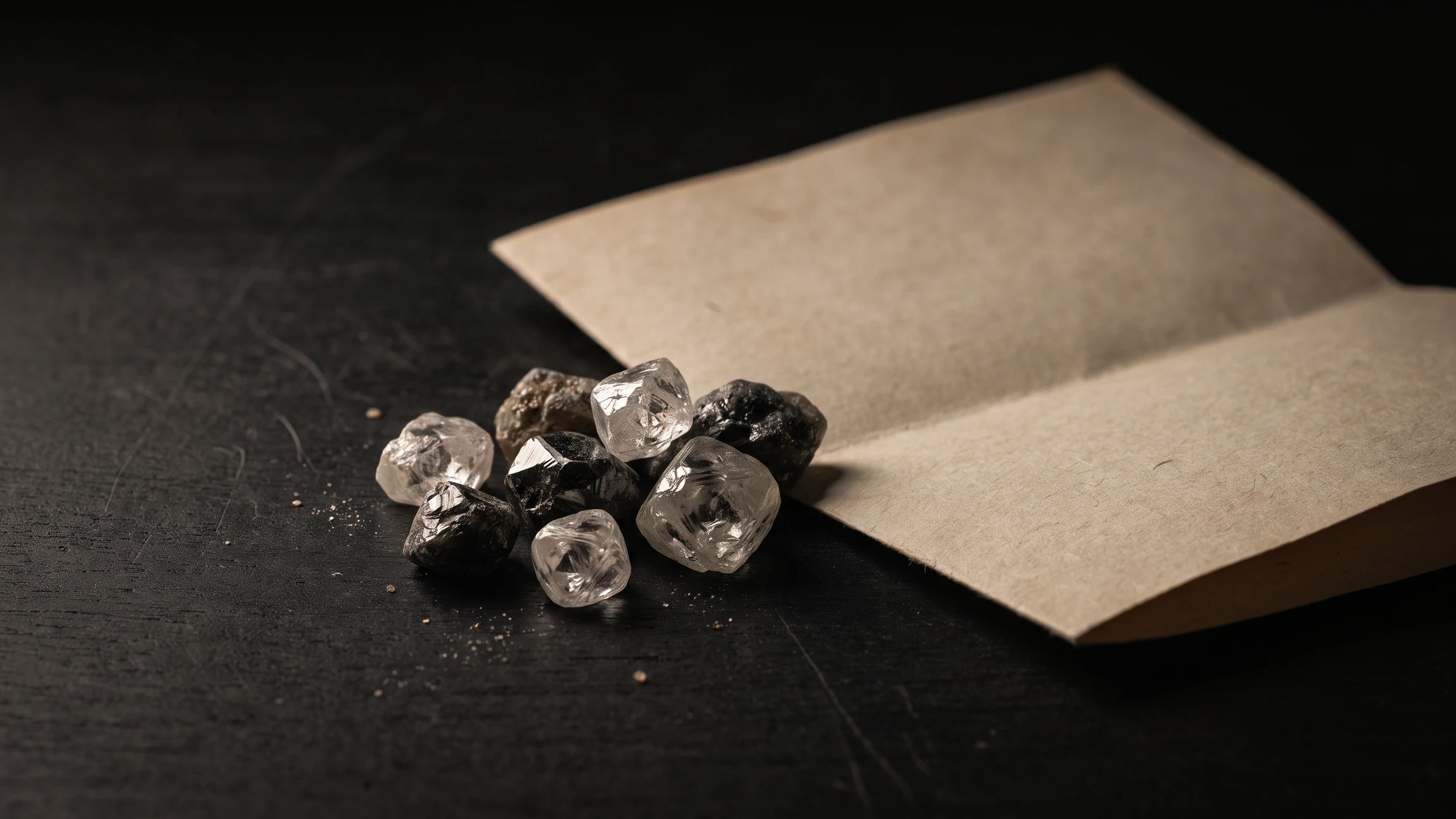
The Kimberley Process is a real instrument with a real achievement behind it, and it is routinely described in shops in terms its own founders would not recognise. The gap is not usually a lie. It is that the scheme answers one question with some rigour, and the question a buyer is actually asking is a much larger one.
What it was built for
It was a response to a specific catastrophe. Through the 1990s, rough diamonds sold across borders funded insurgencies in Sierra Leone, Angola and Liberia — wars whose signature was the mutilation of civilians. The certification scheme that followed was agreed in 2002 and began operating in 2003, taking its wording from United Nations General Assembly Resolution 55/56. Measured against that objective it worked: the trade in rough stones financing those particular rebel armies was substantially closed off.
The definition, read exactly
The scheme defines a conflict diamond as a rough diamond used by rebel movements or their allies to finance conflict aimed at undermining legitimate governments. It is worth reading that sentence slowly, because it contains three limits, and all three are load-bearing.
- Rough
- The certificate accompanies shipments of uncut diamonds between participating countries. Once a stone is cut, it leaves the scheme. The polished stone in a ring does not carry a Kimberley certificate and never did.
- Rebel movements
- The actor matters, not the act. Violence, forced labour or dispossession carried out by a state, by its army, or by a private security company working for it, falls outside the definition — because a government is not a rebel movement against itself.
- Diamonds
- Only diamonds. No ruby, no sapphire, no emerald, no spinel has ever been within the scheme's scope, and none is now. For a house working principally in coloured stones, the Kimberley Process is not a weak assurance. It is simply not an assurance that exists.
What the certificate therefore does not say
- That no one was hurt. Human rights abuse by a state actor is outside the definition, and has been the subject of the scheme's longest and least resolved argument.
- That the mining was lawful, safe, or free of child labour. Working conditions in artisanal diggings are not within scope.
- That the environment survived it — mercury use, river diversion and tailings are not addressed.
- That the polished stone in front of you is the stone that was certified. That link is made by a separate, industry-run mechanism.
- Anything whatsoever about a coloured stone.
The System of Warranties, and what kind of thing it is
The gap between certified rough and the polished stone on a tray is filled by the World Diamond Council's System of Warranties. Each time the goods change hands, the seller adds a declaration to the invoice stating that they were bought from legitimate sources in compliance with the scheme, and companies confirm their compliance through a self-assessment.
It is a chain of statements rather than a chain of custody. Each link is a claim by the party with the strongest reason to make it.
That is not an accusation against the mechanism, which is better than nothing and was designed under real constraints. It is a description of what it can bear. A self-declaration passed along an invoice is evidence of intent; it is not evidence that a particular stone came from a particular place.
Why it has not been widened
Not through inattention. The narrowness has been contested continuously for well over a decade, and the structure of the scheme is what prevents the contest from resolving. Decisions require consensus, so any single participating government can hold a reform indefinitely. And of the three parties at the table — governments, industry and civil society — only governments vote.
Global Witness, one of the organisations that helped bring the scheme into existence, withdrew from it in 2011. The civil society coalition that remains has gone on pressing for a definition resting on whether diamonds finance widespread or systematic violence, rather than on who is committing it. At the plenary held in Dubai in November 2025 the definition was still unchanged.
What to ask instead
None of this makes the scheme worthless. It makes it one document among several, and the wrong one to lean on alone. These questions do more work.
- Where was this stone bought, from whom, and what did they say about where they got it? A named counterparty is worth more than a certificate about a category.
- For a coloured stone, what does the laboratory report say about origin — and does the seller’s account of the supply chain agree with it?
- Is there documentation for this stone specifically, or only a general statement about the house’s buying policy?
- What due diligence framework does the house work to, and will it say what that framework does not establish?
- If the answer to any of these is a logo rather than a sentence, ask again.
Where the House stands
SINGULLUM buys coloured stones, which the Kimberley Process does not reach, and says so rather than borrowing the scheme’s language for reassurance. What the House does do — the OECD five-step framework it works to, what it records for each Creation, and the limits of what any of it establishes — is set out under responsible sourcing. The House claims no certification or trade-body membership it does not hold.
Written to inform. It describes the scheme as published and does not speak for the Kimberley Process, for any participating government, or for any organisation named in it.
The House receives privately. If a stone in this chapter interests you, the conversation begins here.