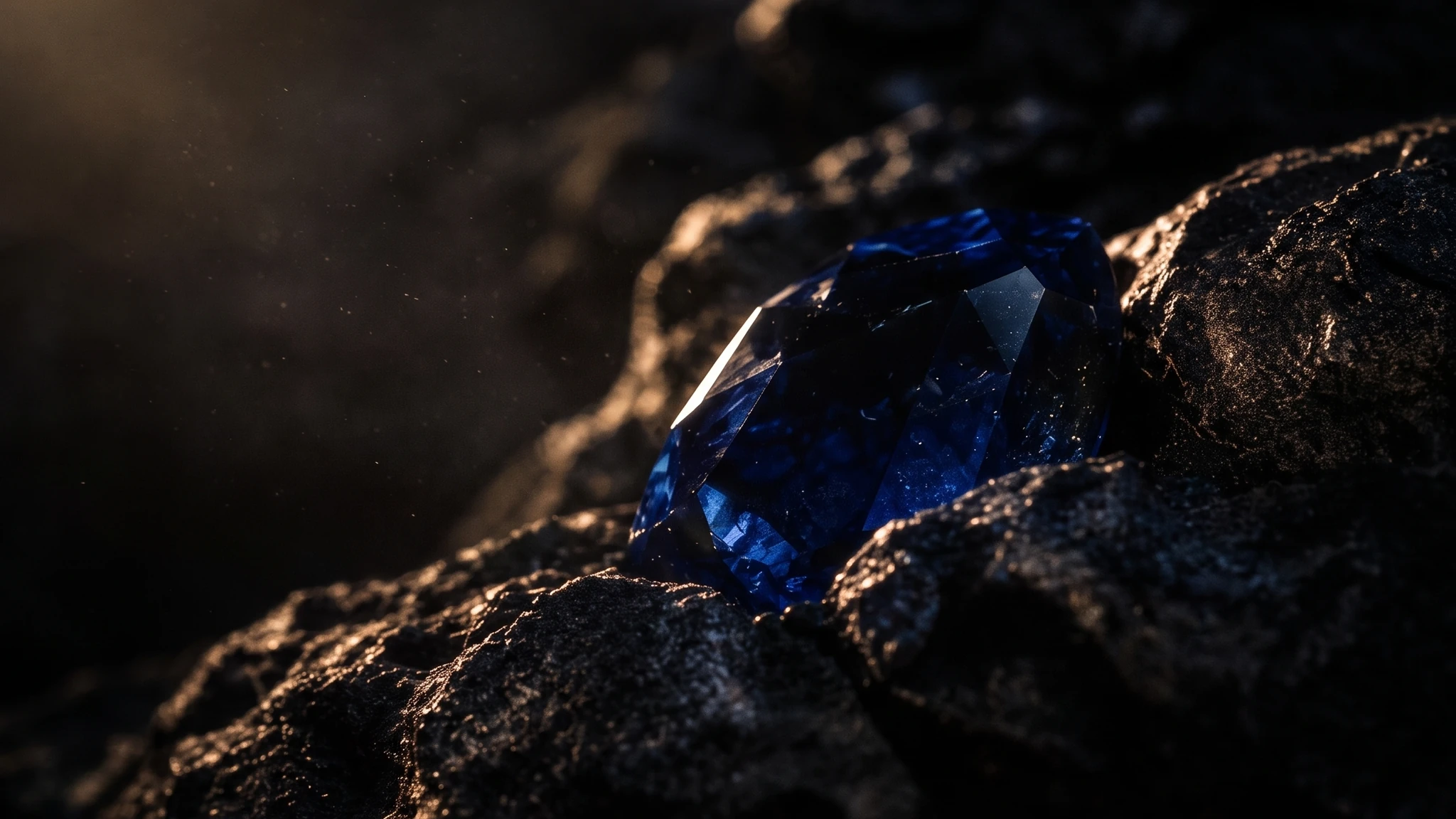
Of all the lines on a laboratory report, one regularly outweighs the rest together, and it is the one that describes nothing you can see. A sapphire attributed to Kashmir, a ruby to Mogok, an emerald to the Colombian mines: each attribution carries a premium far beyond what the stone’s appearance alone would support. It is the largest single lever in the coloured stone market, and it rests on an opinion.
What an origin opinion is made of
A deposit leaves a signature in what grows in it. Two kinds of evidence carry most of the weight. The first is trace-element chemistry: alongside the elements that give a stone its colour sit others, present in vanishingly small quantities, whose ratios vary with the geology that produced them. The second is the suite of inclusions — which minerals were caught inside the crystal as it grew, in what habit, in what company.
A laboratory reads both and compares them against its own reference collection of stones of known provenance, assembled over decades and, in the best cases, gathered at the mines themselves. That collection is the asset. It is why origin determination is concentrated in a handful of houses and why their opinions carry the weight they do.
It is skilled comparative work. It is not a measurement, and no laboratory presents it as one.
Kashmir sapphire, Burmese ruby, Colombian emerald
- Kashmir, for sapphire
- Worked in the Zanskar range of the Himalayas from the early 1880s, and substantially exhausted within a few decades. What exists is what was taken out then. The velvety quality attributed to the finest of them is real and is associated with fine inclusions that scatter light softly — but the premium rests principally on the fact that the source is closed.
- Mogok, for ruby
- The valley in upper Burma that produced the reds against which all others are still described. Supply has been constrained for decades by geology and by politics in turn. In 2015 a 25.59-carat Burmese ruby set by Cartier sold in Geneva for over a million dollars a carat.
- Muzo and Chivor, for emerald
- The Colombian mines, whose particular green — grown in a sedimentary setting rather than the metamorphic one that produces most emerald elsewhere — has defined the top of the category since the sixteenth century. Colombian origin commands a premium over Zambian or Brazilian material at comparable quality.
What the premium is actually paying for
Three things are bundled into it, and they are not of equal standing.
- Genuine scarcity. A mine that is worked out cannot produce more, at any price. This part is geological and it is not going to reverse.
- A real correlation with quality. Certain deposits do, on average, produce stones with the trace-element balance that yields the finest colour — the attribution is a shorthand for a distribution.
- Convention. The market has agreed that these names matter, and the agreement is self-reinforcing: stones with the name fetch more, so the name is worth pursuing, so the name fetches more.
Origin is a fact about where a stone grew. The premium is a fact about what the market has agreed to believe about where a stone grew. They are related, and they are not the same fact.
The second item is the one that matters when you are looking at an individual stone, and it is the one the shorthand obscures. A distribution is not a guarantee. A mediocre stone from a celebrated deposit is a mediocre stone; a superb stone from an unfashionable one is superb. The name describes the average of a population you are not buying.
Where the opinion gets difficult
Deposits formed under similar geological conditions produce similar signatures, and the boundaries between them are not clean. Mozambique has for over a decade produced rubies that are chemically close to Burmese material and visually its equal at the top end — and that trade at a discount to it. Where the data overlaps, two respected laboratories examining the same stone can reach different conclusions, and they occasionally do.
The honest response to an inconclusive result is to say so. A report that declines to state an origin is not a weaker report; it is frequently a more careful one, and a seller who treats it as a defect is telling you something about the seller.
Heat and origin are also separate questions, though they are usually sold as one virtue. Each is a distinct opinion resting on distinct evidence, and the treatment line moves independently of the origin line.
What this means if you are buying
- Look at the stone before you look at the paper, and form a view of it that the paper cannot then talk you out of.
- Ask what the stone would be worth with the origin line removed. That number is what you are buying; the difference is what you are speculating on.
- Check the date on the report. Origin methodology has moved considerably, and an attribution made twenty years ago was made with less to compare against.
- For a stone where origin carries most of the price, a second opinion from another laboratory is proportionate rather than excessive.
- Be most careful where the premium is largest, which is exactly where the incentive to attribute generously is largest too.
Where the House stands
SINGULLUM states nothing about origin that a laboratory or the chain of supply cannot support, and does not lean on a celebrated name to carry a stone that cannot carry itself. The House buys for character — a colour, a proportion, an inclusion sitting where it does — and those are properties of the stone in the room rather than of the region it is assigned to. What the House records for each Creation is set out under responsible sourcing, and how a report should be read is set out separately.
Written to inform. It is not a valuation, an appraisal, or advice on a purchase or an investment, and it does not speak for any laboratory or auction house referred to in it.
The House receives privately. If a stone in this chapter interests you, the conversation begins here.