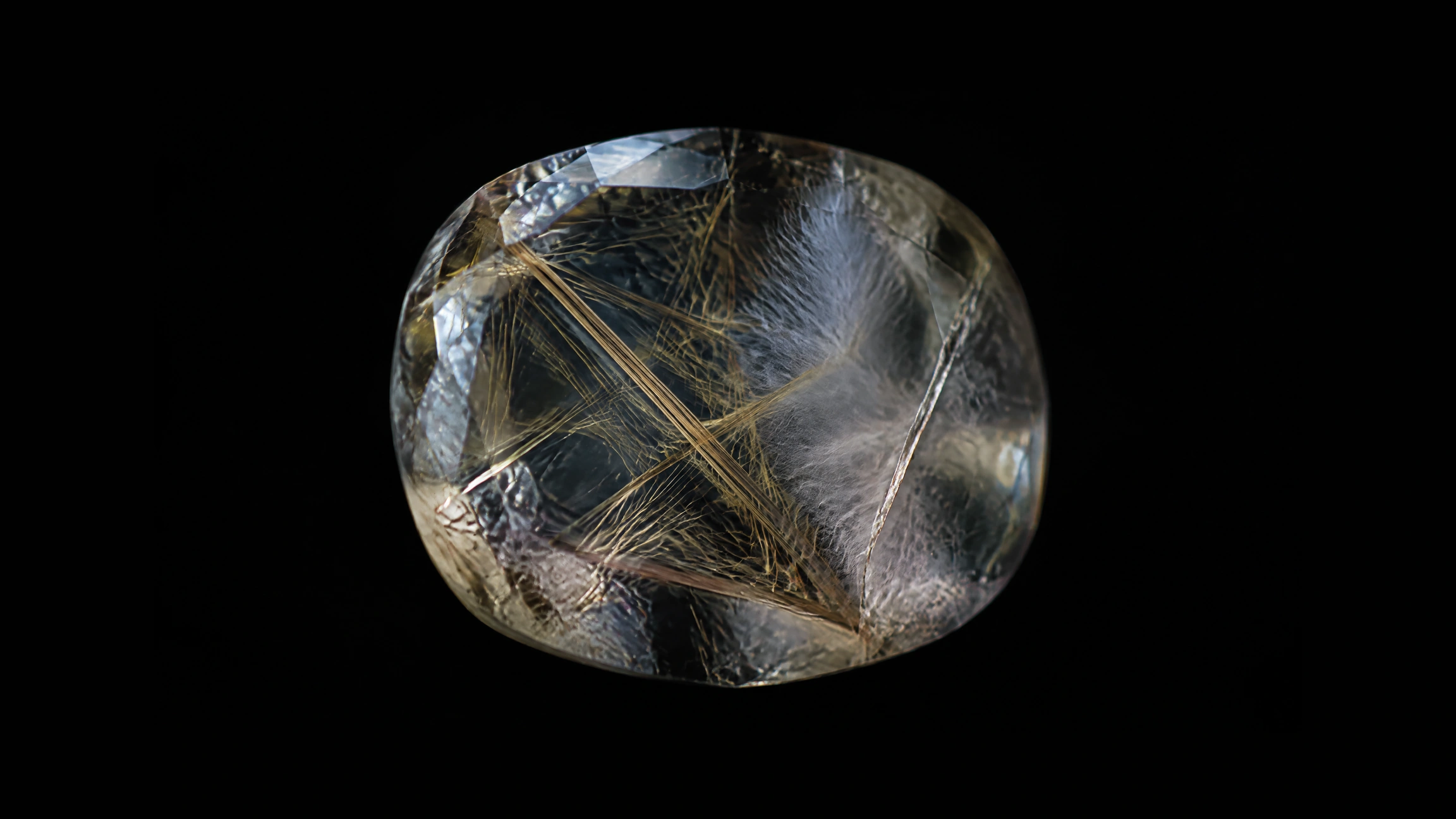
An inclusion is anything enclosed inside a crystal while it was growing, or admitted through a fracture afterwards. It may be a solid — another mineral, caught and overgrown. It may be a pocket of liquid, or of gas, or of both at once with a salt crystal sitting in the middle of them. It may be nothing but a healed break, where the crystal split underground and then closed itself again along a plane that never quite matched.
The vocabulary the trade uses for these features was built for diamonds, and it is a vocabulary of failure. The top of the diamond clarity scale is called Flawless. Everything below it is a deviation from that ideal, measured in how much of the deviation a trained grader can find at ten times magnification. It is a sound scale for a colourless stone whose value lies in the undisturbed passage of light. Applied to a coloured stone, it quietly smuggles in an assumption: that the stone's character is an error rate.
Why coloured stones are not read that way
Gemmologists sort coloured stones into three types by how they habitually grow. Type I stones are usually found clean — aquamarine, tanzanite, blue topaz. Type II stones are usually included: sapphire, ruby, garnet, most tourmaline. Type III stones are almost never clean, because the geological conditions that make them are violent: emerald, red beryl, red tourmaline.
This is not a ranking. It is a statement about what is normal for each species. Judging a Type III emerald against a Type I standard is not rigour; it is a category error. An emerald with no inclusions at all is not the finest emerald in the room — it is the one the room should examine most carefully, because the likeliest explanation is that it was grown in a laboratory.
The named inclusions
Some inclusion scenes are famous enough to carry their own names, and in several cases the name marks a feature that makes the stone worth more, not less.
- Jardin
- French for garden: the mossy, branching network inside an emerald. Emeralds form where beryllium meets chromium or vanadium under pressure, in conditions that fracture the crystal as fast as it builds. The jardin is the visible record of that argument. In the trade an emerald is judged eye-clean or not, at reading distance, rather than at ten times magnification — because the standard has to describe the stone that actually exists.
- Silk
- Fine needles of rutile suspended inside corundum, laid down along the crystal's hexagonal axes so that they cross at sixty and one hundred and twenty degrees. Thin silk scatters light back through the stone and gives it a soft interior glow; the velvety quality associated with the finest Kashmir sapphires is an inclusion effect. Dense enough and regular enough, the same needles produce a star.
- Horsetail
- A spray of fine chrysotile fibres radiating from a point inside a demantoid garnet, curving like a tail. It is the clearest case in gemmology of an inclusion adding value: the horsetail is treated as a hallmark of the Russian Ural deposits, and a demantoid that has one is generally worth more than an equally clean one that does not.
- Three-phase inclusions
- A single cavity holding liquid, a gas bubble and a crystal of salt together. In emerald they point strongly towards a Colombian origin, and origin can be a large part of a stone's price.
- Trapiche
- A six-spoked wheel, formed where impurities gathered along the boundaries between a crystal's growth sectors. It occurs in emerald, ruby and sapphire, it is rare, and it is collected for exactly the pattern that any clarity scale would have to record as a defect.
Inclusions as evidence
Beyond character, inclusions do two kinds of forensic work.
The first is proof of natural origin. Synthetic stones are real stones — chemically and structurally identical to their natural counterparts — but they grow in hours or weeks rather than over a geological span, and they carry the signature of the method. Flame-fusion corundum shows curved growth striae and spherical gas bubbles, because it was built by drops falling onto a rotating boule. Flux-grown material traps residue from the flux it was cooked in. Hydrothermal synthetics can show the seed plate they were grown outward from. A gemmologist identifies a synthetic largely by finding the wrong inclusions rather than by finding none.
The second is identity. The particular arrangement of features inside one stone — this needle crossing that healed fracture, at this angle, beside that crystal — is not repeated in any other stone on earth. Photographed under magnification, an inclusion scene identifies an individual stone the way a fingerprint identifies a person. It is how a stone is recognised after a recut, a theft or a substitution, and it is the reason a serious laboratory report includes a photomicrograph rather than only a number.
What this means when you are buying
- Ask what is normal for the species before you ask what is wrong with the stone. Clean is not a universal virtue; in emerald it is a question.
- Ask where the inclusions sit, not only how many there are. A feature under the table is read at every angle; the same feature under the girdle or beneath a prong may never be seen again.
- Ask whether an inclusion reaches the surface. Those that do are a durability question, not an aesthetic one, and they change how the stone must be set and cleaned.
- Ask for the photomicrograph. A house that has looked properly at a stone will have one and will want to show it to you.
The House's position
We do not search for perfection. We search for character, and inclusions are where most of a stone’s character is kept. An inclusion may be a flaw to the market; to us it is often the reason a particular stone was chosen over a cleaner one beside it — and, once a design has been built in response to it, the reason that design could not be honestly repeated in any other stone. That is the whole of the covenant, stated in terms of mineralogy rather than promise.
Written to inform. It is not a valuation, and it is not advice on a purchase or an investment. Any stone described to you should come with a report from an independent laboratory.
The House receives privately. If a stone in this chapter interests you, the conversation begins here.